
Consistent Resort Visibility Builds Owner Pride and Drives Long-Term Demand
Maintenance fees and assessments form the financial backbone of every timeshare association. These funds sustain operations, preserve amenities, and ensure that long-term reserve obligations are met. When owners fall behind, the impact extends far beyond individual accounts.
Delinquencies place pressure on budgets, strain operational resources, and shift the burden to owners who continue to meet their obligations. Dues recovery, therefore, is not simply an administrative task-it is a core component of the board’s fiduciary responsibility to protect the financial stability of the association and ensure fairness across the ownership base.
The Foundation Begins with Governing Documents
Effective recovery does not begin when an account becomes delinquent. It begins with the governing documents that establish the association’s authority.
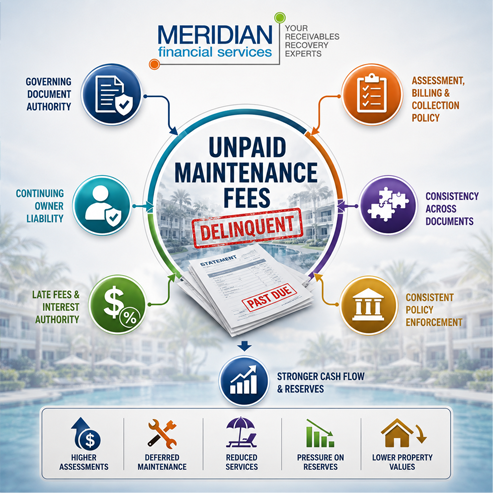
Declarations, bylaws, and properly recorded amendments define the framework for assessments, charges, and enforcement. When that authority is clearly written and internally consistent, recovery efforts tend to proceed efficiently. When language is unclear, inconsistent, or incomplete, the association’s ability to collect what is owed may be limited, regardless of the legitimacy of the balance.
Governing documents define both the obligations of ownership and the rights of the association. They establish what assessments may be charged, when they are due, and what actions may be taken in response to nonpayment. If the documents fail to support a specific charge or recovery method, the association may face delays, reduced recovery amounts, and increased administrative effort. Over time, these limitations can weaken the association’s financial position and complicate routine operations.
Clarifying Ongoing Financial Obligations
Timeshare ownership introduces a unique dynamic. Maintenance fees are recurring obligations rather than one-time balances. Governing documents must clearly support the association’s authority to assess these fees on an ongoing basis and to continue pursuing them as they become due. This clarity is particularly important when owners stop using the property but remain financially responsible.
Without explicit language confirming continuing liability, associations may encounter disputes or delays that complicate recovery. Clear provisions reinforce expectations and reduce ambiguity. They also support consistent enforcement, ensuring that all owners are held to the same standard regardless of usage patterns or individual circumstances.
Late Fees, Interest, and Recovery Costs
Late fees and interest charges are often included in delinquent balances, yet they require clear and consistent support within the governing documents. These provisions should define when such charges apply and how they are calculated. When the language is vague or absent, these amounts may be subject to challenge, resulting in adjustments that reduce recoveries and increase administrative workload.
Recovery-related costs present a similar concern. Associations frequently expect that expenses incurred during the collection process can be added to the delinquent balance.
Whether those costs are recoverable depends entirely on the governing documents. When authority is clearly stated, these expenses can be included. When it is not, the association may be forced to absorb them, effectively spreading the financial impact across all owners.
The Role of Assessment and Collection Policies
While governing documents establish authority, policies provide operational clarity. A well-drafted Assessment, Billing, and Collections Policy outlines how that authority is applied in practice. It defines when assessments are billed, when accounts are considered delinquent, how late fees are applied, and what steps follow when balances remain unpaid.
Documented policies improve communication by setting clear expectations for owners. When procedures are transparent and consistently followed, misunderstandings are reduced, and recovery efforts proceed more smoothly. Consistency ensures that all owners are treated uniformly, reducing the risk of perceived inequities.
Aligning Documents for Effective Enforcement
Many associations operate under governing documents created at different points in time, with amendments layered over years. When these provisions do not align, uncertainty arises. One document may authorize certain charges while another remains silent. These inconsistencies can complicate recovery efforts and slow resolution.
Periodic review of governing documents helps identify these gaps and provides an opportunity to strengthen alignment. Even modest updates that clarify assessment authority or continuing liability can significantly improve recovery outcomes.
Addressing Legacy Resort Challenges
Legacy resorts often face additional complexity. Documents drafted decades ago may not reflect current operational realities or financial expectations. Updating governing documents is not always straightforward, particularly when owner approval thresholds are difficult to achieve.
When amendments are not practical, associations can improve clarity through structured policies that operate within the existing framework. Establishing clear operational guidelines often leads to improved recovery outcomes.
Building Strength from the Outset
Newer associations benefit from the opportunity to establish clarity from the beginning. Well-structured governing documents create a strong foundation for consistent enforcement. Clear authority reduces disputes and supports long-term financial stability.
Financial Impact and Long-Term Stability
The financial implications of strong governing documents and consistent policies are significant. Efficient recovery returns funds more quickly, supports operating budgets, and protects reserves. When recovery is delayed, shortfalls may lead to increased assessments, deferred maintenance, or reduced services. Clear authority and structured procedures help associations maintain stability and ensure that financial obligations are applied consistently across the ownership base.
A Proactive Path Forward
Associations that evaluate their governing documents and implement structured Assessment, Billing, and Collections policies position themselves for stronger recovery outcomes. Clear authority, aligned provisions, and transparent procedures create a framework that supports consistent enforcement and improved communication with owners.
For many legacy timeshare associations, identifying gaps in governing documents or developing structured policies can be challenging without industry-specific experience. Meridian Financial Services works collaboratively with boards and management teams to review governing documents, evaluate assessment authority, and assist in developing practical collection frameworks tailored to timeshare ownership.
By aligning governing authority with clear operational procedures, associations can improve recovery outcomes, reduce administrative burden, and better protect the financial health of the resort. A proactive review often provides meaningful insight, and Meridian partners with associations to support this process and help build a sustainable, well-structured approach to dues recovery.
For more information, contact:
Gregory Sheperd, Chief Executive Officer, Meridian Financial Services, 828-575-5179, gsheperd@Merid.com, Website: www.merid.com