
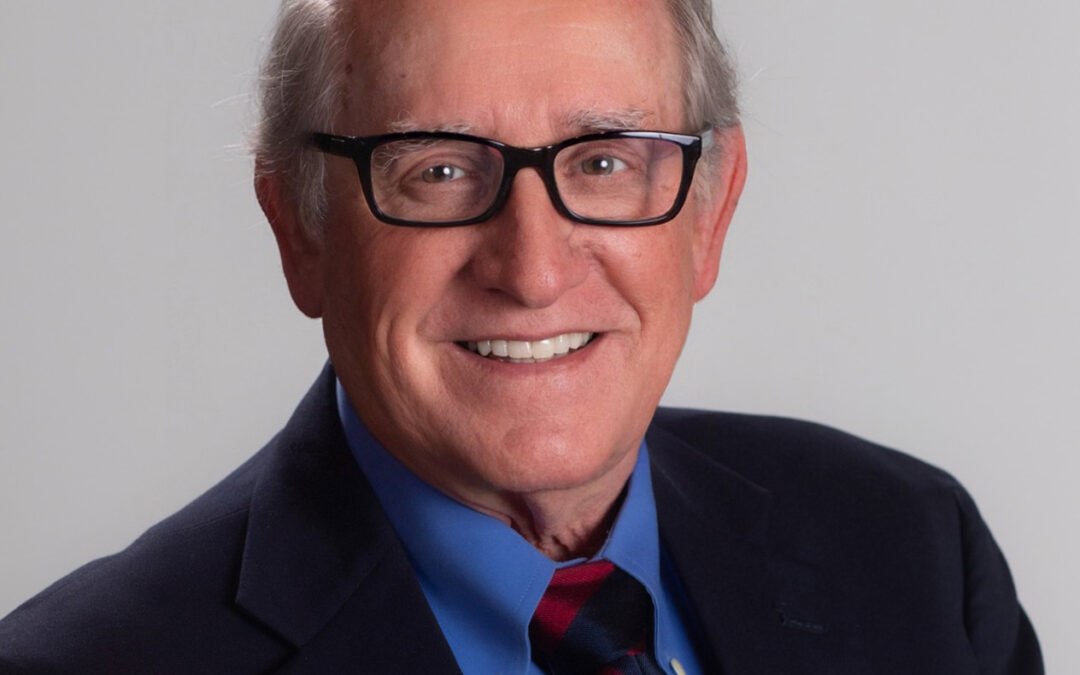
The Accountant Who Rewrote the Rules: Gary Porter’s Five-Decade Mission to Protect Timeshare and Condo Associations
By Shep Altshuler, Publisher, TimeSharing Today Magazine
From decoding IRS Form 1120-H in 1976 to challenging the Big Four accounting firms, how one CPA became the industry’s most trusted authority on taxation and reserve studies
Some people find their calling early in life. Gary Porter found several—and masterfully wove them together into a career that has transformed how timeshare resorts and condominium associations approach financial management across America.
Humble Beginnings in California Wine Country
Long before Paso Robles became synonymous with world-class wines, it was simply home to a young Gary Porter, growing up on a 500-acre cattle ranch where his father served as foreman and general manager. The rolling hills of California’s Central Coast, provided an unlikely training ground for someone who would eventually author the definitive guides on association taxation and reserve studies.
“I grew up there and made lots of friends in the ranching industry,” Porter recalls. “All through high school and college, I worked on different ranches. It was great because I had flexible schedules that allowed me to go to school three days a week and work four days a week.”
The responsibilities were demanding and diverse—maintaining ranch infrastructure, working with livestock, running harvesters and tractors, rebuilding pumps and windmills, and keeping aging equipment operational. Porter learned to drive a jeep at thirteen, developed mechanical skills out of necessity, and gained a deep appreciation for hands-on problem-solving.
When his second daughter was born and the doctor questioned whether he could handle being in the delivery room, Porter’s response was characteristically pragmatic: “I’ve delivered over a hundred calves. I’m pretty sure I can do this.”
An Unexpected Turn Toward Architecture—and Then Accounting
Porter’s original dream was to design buildings. He enrolled at California Polytechnic State University in San Luis Obispo as an architecture student, supported by a scholarship that covered his tuition. He had even completed three years of college-level civil engineering courses during high school, driven by a passion for design that dated back to grade school.
But fate, and an accounting professor named Victor Wolcott, had other plans.
“I unknowingly selected the toughest accounting professor in the college,” Porter explains. “He had three classes that quarter, about 60 students each, so about 180 students in total. And he gave one A, one B, and then a whole bunch of C’s and a few D’s and F’s. I got the only A he gave that quarter beating out everyone in the accounting school, and here I wasn’t even an accounting major—I realized, you know what? I really loved it. I need to switch majors.”
That single accounting course changed everything. Porter graduated in less than four years—a feat he notes students can’t accomplish today—and immediately joined the CPA firm now known as Deloitte & Touche in Los Angeles.
Five Years That Shaped a Career
Porter’s time at Deloitte from the early to mid-1970s reads like a Cold War thriller. As a self-described “raw, immature little kid, straight off the farm,” he was thrust into diverse assignments spanning retail, manufacturing, and aerospace industries. His first day found him working in Watts—”not a good place for a scrawny little rancher kid to go,” he admits.
The capstone of his Deloitte career came with an extraordinary project: building a cost manual and monitoring costs for an electronic defense system being developed by an American defense contractor for the Iranian Air Force, then a US ally. Because U.S. companies can’t contract directly with foreign militaries, the Deloitte contract technically ran through the CIA.
“I was given a temporary Department of Defense top secret level clearance as they processed my application so that I could review all the documents,” Porter recalls. “I actually had access to everything military-related in the entire Middle East at that time because it all played into the defense of the country of Iran against any of its potential neighbors. And at that time, Iran was having conflicts with neighboring Iraq.”
After six months on that assignment, Porter realized the role had inadvertently sidelined him from his regular client work. In July 1976, he decided to leave and join a smaller firm in Ventura, California—a decision that would launch his specialization in association taxation.
The Genesis of an Expertise
Just three months into his new position, in October 1976, a partner approached Porter with a challenge: “Here’s a new tax form called 1120-H that the IRS just created. Look at this form, read the instructions, figure out what to do because we’ve got some homeowners association clients.”
That moment marked the genesis of Porter’s unparalleled expertise in association taxation. The form represented Congress’s solution to a unique problem—homeowners’ associations, condominium associations, and timeshare resorts didn’t fit neatly into any existing tax category.
“They fit somewhere in the middle—they are incorporated as nonprofit mutual benefit corporations, so they’re there to serve their members, but they happen to have some profit-making activities also,” Porter explains.
Code Section 528, enacted in 1976, created a special tax treatment allowing associations to pay taxes only on non-member income like interest earnings, while exempting all member activities from taxation—even if those activities resulted in net income.
“By virtue of reading it, understanding it, working with clients back in 1976, I established myself as being an expert in the financial aspects of homeowners associations,” Porter says. The expertise eventually expanded the firm to serve approximately 800 associations.
Building a Publishing Empire
Porter’s reputation as the go-to authority on association taxation was solidified through an unlikely channel—book publishing. When Thomson Reuters’ division Practitioners Publishing Company (PPC)—which maintains roughly 90% market penetration among CPA practices—declined his offer to write a guide on homeowners associations, Porter self-published one himself.
For three years, he managed to generate nearly $100,000 in book sales revenue. “I found out that the publishing business is really tough,” he admits with characteristic honesty. “I managed to lose money doing a hundred thousand worth of business.”
But that self-published book became his calling card. Thomson Reuters found it in the libraries of the American Institute of Certified Public Accountants and the Financial Accounting Standards Board—institutions that had granted Porter permission to reprint portions of their copyrighted material and, in return, required copies of his book for their collections.
PPC bought his copyrights and hired him as their subject matter expert and author. Since 1990, Porter has updated the guide annually. He recently completed the 36th edition.
The impact has been staggering: “It’s generated tens of millions in revenues,” Porter notes. “I’m very proud of the fact that my writings have produced such an incredible amount of revenue.”
In addition, more than 400 articles and being published or quoted in general publications such as the Wall Street Journal, Money Magazine, Kiplinger’s Personal Finance, and The Practical Account, and trade publications Timesharing Today, Hawaii Building Trades, Florida Community Association Journal, and more than a dozen major newspapers.
The Timeshare Connection
Porter’s entry into the timeshare industry came through a speaking engagement. In May 1987, he was invited to present at the CAI (Community Associations institute) conference in Miami on association finances. In the audience sat the president of a timeshare management company, impressed by Porter’s expertise.
“He asked me to work with him,” Porter recalls. “We started working with about a dozen of his timeshare resorts and nine of those are still clients of our CPA firm today.”
That introduction launched Porter’s decades-long involvement with timeshare associations. He became instrumental in a critical legislative victory for the industry: allowing timeshare resorts to use Form 1120-H.
“Code Section 528 came into effect in 1976, and it was 20 years later that a group of timeshare resorts based out of the Jacksonville IRS district office were subject to audit because timeshare resorts were not permitted to use Form 1120-H,” Porter explains. “ARDA did a great lobbying effort and got Representative Clay Shaw from Florida, who was on the Ways and Means Committee, to offer an amendment to Code Section 528, which allowed timeshare resorts to also use that form.”
Today, Porter notes, almost every timeshare resort uses Form 1120-H because of the tax safety it provides.
The Reserve Study Revolution
While Porter’s tax expertise alone would constitute a remarkable career, he simultaneously pioneered advances in reserve study methodology that have reshaped industry standards.
In 1982, a management company owner approached him: “We want to do a reserve study. I know the physical side of this, but you’re a CPA—you would know the budget side of this. Can we do one together?”
Porter insisted on participating in the site work, where his architectural training proved invaluable. “What came natural to me at the time, and yet nobody else in the reserve study industry started doing until the last couple of years,” he notes, was asking about maintenance history and future maintenance plans for every component.
In 2003, Porter separated his reserve study work into a distinct entity, initially called Reserve Consultants International, later renamed Facilities Advisors International in 2006. The company now performs reserve studies nationwide and in several countries, including Canada, Mexico, Caribbean nations, South Africa, and Brazil.
A Different Approach to Reserve Studies
Porter’s methodology differs fundamentally from most reserve study preparers, who typically come from engineering or construction backgrounds.
“When I look at the reserve study process, I see three things they don’t see,” Porter explains. “The first thing is the onsite analysis of physical components really has very little to do with architecture, engineering or construction. It has everything to do with maintenance.”
In 2016, Porter earned the Facilities Management Professional (FMP) credential—one of only 20,000 people worldwide to hold this advanced designation, and one of the few to earn it without working full-time in facilities maintenance.
The second critical element is valuation. “You have to price it right,” Porter emphasizes. “When I try to talk pricing with some of my peers or my competitors out there, they don’t even understand what a cost element is.”
Porter uses the example of televisions in a timeshare resort: “Most reserve preparers look at that and say, ‘A television costs $500. We’ve got 400 of them, so we’ve got a couple hundred thousand.’ They’re forgetting sales tax—average it at 8%, and all of a sudden, you’re missing at least $16,000 there. Add on installation costs of about $130, and if you need to replace the bracket on the wall, that’s typically an extra $150. What they see as a $500 cost grows to about $800.”
The third component is financial reporting—an area where Porter’s CPA training provides unique advantages. “The American Institute of CPAs created a set of protocols for financial reporting literally more than a century ago,” he notes. “All reserve preparers, I think, except me, are totally oblivious to the fact that those protocols even exist.”
Creating New Industry Standards
Frustrated with what he viewed as deficient standards from the leading industry trade organization, Porter led an effort to create more robust protocols. In 2012, a group of 16 professionals from six different countries began developing standards that were published in 2014 by the International Capital Budgeting Institute (ICBI).
“We got immediate resistance from everybody in the industry, basically saying, ‘Who do you think you are trying to create standards?'” Porter recalls. But he came to the effort with unique qualifications: four years as chairman of the Accounting Principles and Auditing Standards Committee for his local CPA chapter, and serving on the 16-member state committee in California.
“Nearly two-thirds of the nearly 700,000 CPAs in the United States come from just four states—California, Texas, Florida, and New York,” Porter explains. “When FASB and AICPA talk to the accounting profession, they pay a lot more attention to those four states. For four years, I was one of those 60 or so people with outsized influence on professional standards development.”
“I am both experienced and informed on the development of professional standards,” Porter says. “When we designed the standards for ICBI, I made sure that we were meeting all three criteria that make accounting standards universally accepted: clarity, consistency, and comparability.”
A Practice Built on Expertise
On January 1, 1980, Porter launched his own CPA firm. For nearly three decades, he maintained a general practice serving corporations, partnerships, individuals, and associations. Around 2008, he made a strategic decision to focus exclusively on homeowners and timeshare associations.
“For nearly 20 years, all I’ve dealt with is homeowners and timeshare resorts,” Porter says. “No individual tax work, no corporate tax work. I don’t even do my own tax return anymore. I hired another CPA to do my tax return.”
The specialization has paid dividends. Today, Porter and Lasiewicz CPAs (Porter’s partnership with Cheryl Lasiewiz for the past ten years) serve clients in 22 states. His reserve study company Facilities Advisors International operates through regional offices covering the entire country.
Porter’s reputation extends far beyond his immediate clients. “I’ve had CPAs and tax attorneys from all over the country calling me regularly, and I have done pro bono consulting with over 500 CPA firms nationwide,” he notes. “I still get calls from CPAs and tax attorneys every year whenever they get stuck in a tax audit and realize they don’t know what’s going on. They hit the internet to see who does, and my name pops up.”
The results speak for themselves: Porter has consulted on over 70 IRS audits for associations, with only two involving tax returns he prepared. He’s also helped large property owners’ associations achieve tax-exempt status under Code Section 501(c)(4), generating accumulated tax savings exceeding $30 million for those clients.
Taking on the Big Four
Perhaps most remarkably, Porter has successfully challenged work performed by all four major international accounting firms—Deloitte, PwC, EY, and KPMG—his former employer among them.
“I have been in direct mediation with them, getting large settlements for my clients as these large firms failed to understand the tax law,” Porter says matter-of-factly. “Bigger isn’t better. Their large firms are incredibly powerful, knowledgeable, and skilled at what they do, but this is not an industry where they have expertise. Whereas a smaller firm like mine, we devote ourselves to it 110%. We get it, and we make it happen.”
Credentials and Recognition
Porter’s wall of credentials reflects his multi-disciplinary expertise:
- CPA: Certified Public Accountant
- RS: Reserve Specialist (Community Associations Institute)
- RSS: Reserve Study Specialist (licensed by the State of Nevada—the only state requiring reserve preparers to be licensed)
- RRC: Registered Reserve Consultant (requiring 24 hours of education and a comprehensive examination—only two people have earned this credential issued by the Budgeting Professionals Credentialing Board)
- FMP: Facilities Management Professional (International Facilities Management Association)
He’s testified as an expert witness in court more than 50 times on valuation, reserve, accounting, and tax issues. He’s been hired by CAMICO, an insurance company serving California CPAs, to defend member firms in malpractice cases related to homeowners associations and reserve studies.
Porter also serves as update author for the California Continuing Education of the Bar’s chapter on homeowner associations—the guide used by every lawyer in California.
“Reflecting back I realize I’ve accomplished some good things, but I’ve actually learned more from my failures. Those helped shape me, perhaps even more than the successes.”
The Personal Side
Throughout his remarkable career, Porter has maintained diverse interests. About 40 years ago, seeking to engage his children in physical activities, he enrolled them—and himself—in karate school. He ultimately qualified for green belt in Kenpo Karate, one step below brown belt.
“I had to give it up because of my travel schedule,” he explains. “I just couldn’t attend the school. But it’s something that I’ve thoroughly enjoyed and I’ve never once used and hope that I never have to use.”
Porter is also an avid reader, having completed a speed-reading course in college that brought his reading speed to the high 1,800 words per minute—roughly six times faster than average. “I’ve probably read thousands of books,” he estimates. “I know I have several hundred books on my Kindle, and I’ve only had my Kindle for just a few years.”
When reading for pleasure, Porter blazes through material. But when conducting research, his approach transforms completely. “My reading speed drops to practically zero,” he admits. “I sit there and parse every word and try to understand what the possible meaning of each of these words is and how they could be interpreted to mean anything else.”
Porter married his high school sweetheart; they had two children during their ten-year marriage. He met his second wife, Karlene, in the late 1970s while working at a CPA firm in Ventura. They’ve been married for 45 years and together share four children, nine grandchildren, and eight great-grandchildren.
A Living Legacy
Now based in Las Vegas while maintaining his California practice, Porter continues to shape the industries he’s served for nearly five decades. He regularly speaks at industry conferences—including upcoming presentations for the Florida Institute of CPAs and at the Cooperator trade show on structural integrity reserve studies—and continues updating his definitive texts on association taxation and reserve studies.
The royalties from his Thomson Reuters guide provide financial freedom that allows him to research and write without the pressure of client billables—a luxury that keeps him at the forefront of industry knowledge. “I get paid to write, I get paid to research and come up with this information,” he says. “That allows me a freedom that really nobody else has.”
For timeshare resort property managers and condominium association professionals navigating increasingly complex financial, tax, and reserve study requirements, Gary Porter represents more than just an expert consultant. He’s the architect of the very frameworks they rely on—frameworks built on a foundation of ranching work ethic, architectural vision, accounting precision, and an unwavering commitment to getting it right. Ha has held a number of leadership positions including serving as CAI’s national president in 1998.
From delivering calves on a California cattle ranch to providing clarity on Code Section 528, from rebuilding motors to rebuilding industry standards, Gary Porter’s journey proves that expertise isn’t just about knowing your field—it’s about seeing connections others miss, asking questions others don’t think to ask, and having the courage to challenge even the most prominent players when the work demands it.
“We devote ourselves to it 110%,” Porter says of his team’s approach. “We get it. We make it happen.”
For nearly half a century, he’s done precisely that—and timeshare resorts and condominium associations across America are better for it.